

Welcome to this clear guide to IPTV UK services. If streaming choices feel overwhelming, you are not alone. It explains how to choose, prepare for, and use an IPTV service.
This article covers devices, apps, and their streaming abilities. You will learn to check broadband speed for smooth viewing. We also explain compatible apps and devices for smart TVs, tablets, and more.
You will learn why authorised services matter and how to respect UK laws. By the end, you can make informed choices about IPTV UK options and subscription plans that suit your needs. Let us begin exploring IPTV.
Key Takeaways
- This guide simplifies the process of choosing and using IPTV services.
- Understand the requirements for broadband speed and device compatibility.
- Learn about various apps and their streaming capabilities.
- Discover how to improve playback quality and manage subscriptions.
- Emphasise the importance of using authorised services and adhering to UK laws.
What IPTV UK means and how it works
IPTV UK is a modern way to watch television through the internet. It sends programmes through an internet connection, not broadcast, satellite, or cable systems. This gives viewers a flexible, easy-to-use viewing experience.
To understand IPTV, learn a few key terms.
Understand internet protocol television
Internet protocol television (IPTV) lets you receive television programmes through the internet. Unlike traditional services, it streams content straight to your device. You can watch shows and movies on demand.
See how live television streaming and video on demand work
IPTV has two main categories:
- Live television streaming: This feature lets you watch channels as they are broadcasted in real-time.
- Video on demand: This allows you to select and watch programmes or films at your convenience, giving you control over your viewing schedule.
Know what you need before you start
Before using IPTV, make sure you have these essentials:
- A reliable broadband connection to support streaming.
- A compatible smart TV or streaming device.
- An approved IPTV application to access content.
- Your provider’s login or playlist information.
Each part has an important role: the IPTV service provides access and content. The app organises and plays content, while the device shows it on your screen. Services may offer different channels and features, so choose carefully.

For more information about IPTV service terms and conditions, visit this link.
Decide what you need from an IPTV service
To make an informed choice about IPTV UK, first outline your viewing needs. This helps ensure the service suits your household’s entertainment preferences.
List the channels, on-demand content and features you want
Think about the channels your family enjoys, such as sports, news, entertainment, or regional programming. A list can simplify your search for the right service. Also, consider whether you need:
- Live sports channels
- News networks
- Children’s programming
- On-demand content for binge-watching
- Catch-up viewing options
IPTV providers do not all offer the same channel line-up or on-demand features. A longer subscription is not always better value if it lacks the content you want.
Consider who will watch and how many devices you will use
Next, consider who will use the service and how many people will watch. A family with several viewers may need a plan supporting simultaneous connections. A sole viewer may prefer a cheaper, single-connection plan.
Also, consider the devices you already own. Will you stream on a smart TV, tablet, or mobile phone? Checking compatibility helps provide smooth viewing with your IPTV UK service.
As the old saying goes,
“The best way to predict the future is to create it.”
This idea also applies to choosing IPTV UK services. By considering your needs, you can choose a service that fits your viewing habits and lifestyle.
| Feature | Single Connection Plan | Multi-Connection Plan |
|---|---|---|
| Number of Users | 1 | Up to 5 |
| Channels Available | Basic Package | Premium Package |
| On-Demand Content | Limited | Extensive |
| Catch-Up Viewing | No | Yes |
Step 1: Check your broadband speed and connection
Before exploring IPTV, check whether your broadband connection can support streaming. A reliable connection can improve your viewing experience. Run a broadband speed test near the device you plan to use. It shows your current internet speed.
Your speed can change during peak hours. Gaming, video calls, downloads and cloud backups can use bandwidth and reduce streaming quality.
Measure your broadband speed and consider household usage
Use a reputable speed-test website to measure your broadband speed. This shows whether your connection meets the broadband speed requirements for IPTV. At least 5 Mbps is generally recommended for standard definition, while 25 Mbps or more suits high definition.
Here’s a quick overview of the speeds you might need based on the quality of the stream:
| Streaming Quality | Recommended Speed (Mbps) | Typical Usage |
|---|---|---|
| Standard Definition (SD) | 5 Mbps | Casual viewing |
| High Definition (HD) | 25 Mbps | Family watching |
| Ultra High Definition (4K) | 50 Mbps | Heavy streaming |
Choose between Wi-Fi and a wired Ethernet connection
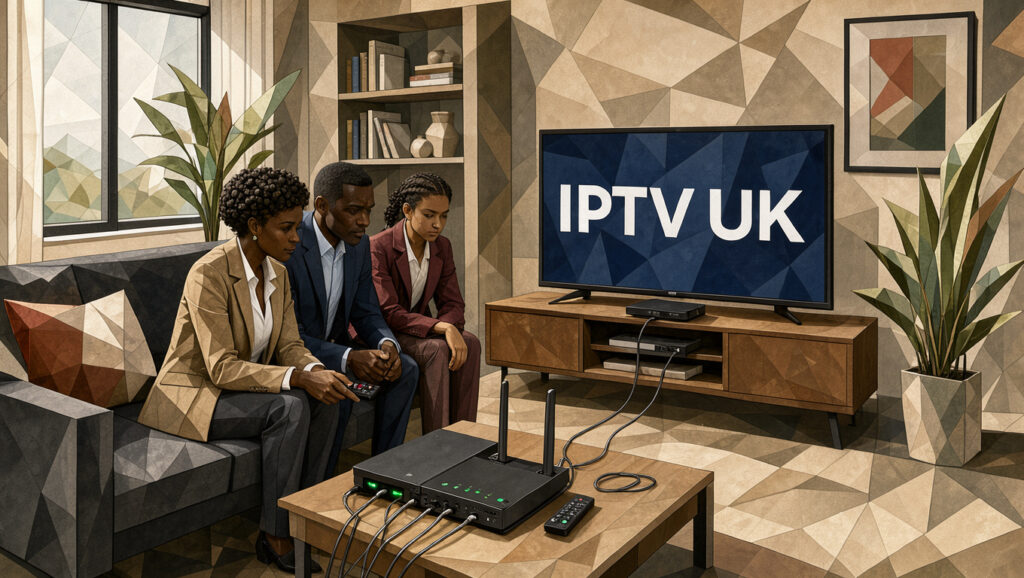
Next, choose between Wi-Fi and a wired Ethernet connection. A wired connection is usually more stable and less affected by interference. That can help prevent interruptions during streaming. Wi-Fi is convenient, but walls or distance from the router may weaken its signal.
If you choose Wi-Fi, place your router centrally in your home. Make sure it supports modern standards, such as Wi-Fi 5 or Wi-Fi 6, for better signal strength and performance.
Allow for the speed needed by your chosen streaming quality
Allow extra bandwidth beyond the minimum broadband speed requirements. Streaming services recommend a buffer for changes in speed. For example, HD streaming needs at least 30 Mbps to help avoid buffering.
Overall, meeting broadband speed requirements and choosing Wi-Fi or Ethernet can improve your IPTV experience. For more detail on measuring broadband speed, read this guide on broadband speed testing.
Step 2: Check IPTV device compatibility
Check your IPTV device before choosing a service for smooth viewing. Devices have different features, so match yours with your provider’s requirements.
Compare smart TVs, Android TV devices and Amazon Fire TV devices
Smart TVs are popular for IPTV, but some models lack the needed apps. Android TV devices, including Nvidia Shield and Xiaomi, often offer better app support and updates. Amazon Fire TV devices are easy to use and offer many IPTV apps to download.
Check support for Apple TV, mobiles, tablets and computers
Apple TV offers a smooth interface and reliable app availability. For mobile or tablet viewing, check that your IPTV service supports your device’s operating system. Compatibility varies, so check before committing.
Confirm your device’s operating system, storage and network support
Check your device’s operating system version, available storage and network features. Some IPTV apps need certain OS versions to work correctly. Also check for Wi-Fi or Ethernet support, because it can affect streaming quality.
An app available on one platform may not work on another, even when both devices share a brand. Ensuring streaming device compatibility helps you enjoy IPTV without interruptions.

Step 3: Choose a smart TV or streaming setup
For seamless IPTV UK viewing, choose the right smart TV or streaming device. Your device must support the apps your IPTV service needs. This choice can strongly affect your viewing experience.
Check whether your smart TV supports the required app
Start by checking your smart TV’s features. Open its official app store and search for the IPTV application you plan to use. If you find it, download it directly; if not, your TV may not support it.
Use a compatible streaming device if your TV is unsupported
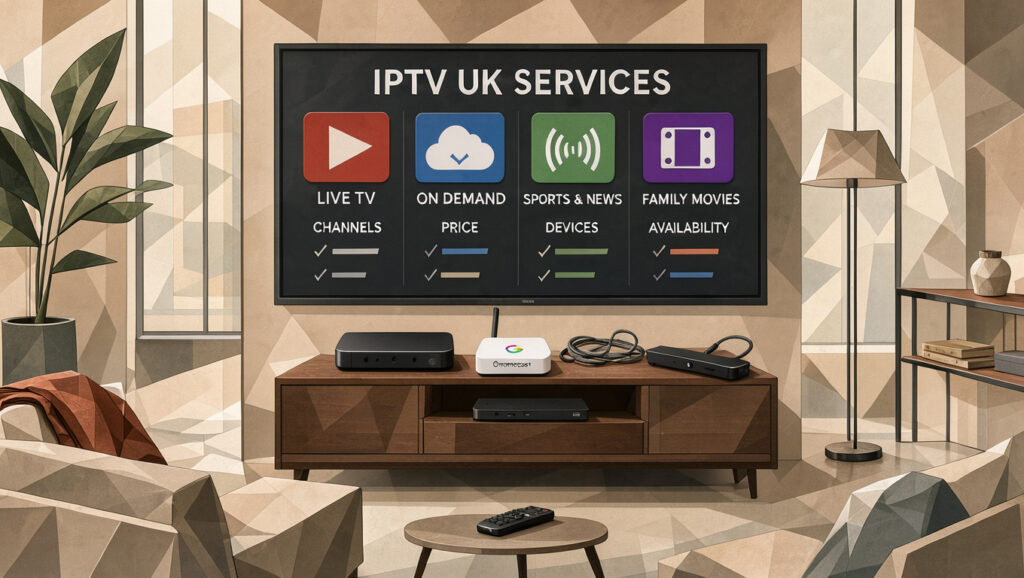
If your smart TV lacks the required app, use a compatible streaming device. You can connect a Roku, Amazon Fire Stick, or Google Chromecast through HDMI. This lets you use the IPTV UK app and gives you more viewing choices.
Connect and position your device for reliable streaming
Connect it to your TV with an HDMI cable. Select the correct TV input to show the device’s interface. Then follow the device’s network setup instructions.
For reliable streaming, place the device where few objects block it. Keep it away from walls and enclosed spaces, which can trap heat. Also, place your router or mesh network node centrally for a strong signal.
Check that all needed cables, including HDMI and power, are firmly connected. Keep the remote control nearby for easy navigation.
An external streaming device can extend an older TV’s life. However, it cannot fix an unsupported service or weak internet connection.
| Device Type | Supported Apps | Connectivity | Price Range |
|---|---|---|---|
| Smart TV | Varies by brand | Wi-Fi/Ethernet | £300 – £1,500 |
| Amazon Fire Stick | Most popular apps | HDMI | £30 – £50 |
| Roku | Wide range of apps | HDMI | £30 – £100 |
| Google Chromecast | Compatible apps | HDMI | £30 – £40 |
Step 4: Select an IPTV app that works with your service
Your IPTV app can change how you enjoy your content. It provides the interface that organises and plays content from your IPTV service. Check that it works with both your device and provider.
Check app compatibility with your device and IPTV provider
First, confirm the app works with your device. Not every app supports all devices or IPTV providers, so check before choosing one. Some apps need playlist formats or login methods supplied by your provider.
Compare ease of use, electronic programme guide support and playback options
Next, assess the app’s interface and electronic programme guide support. Choose clear navigation that helps you find content quickly. Also check its playback options.
- Electronic programme guide: This feature allows you to see what’s currently on and what’s coming up next.
- Playback controls: Ensure the app has stable playback options, including pause, rewind, and fast forward.
- Catch-up functions: This allows you to watch shows you may have missed.
- Favourites and subtitles: These enhance your viewing experience by allowing you to customise your content.
Install apps only from official app stores or trusted sources
Finally, download apps from official app stores or trusted sources approved by your device maker or service provider. Avoid unofficial downloads and apps requesting unnecessary permissions or payment details, as they can create security risks.
Step 5: Set up your IPTV service safely
Set up your IPTV service correctly for a smooth experience. Prepare your subscription and device, install the app, and protect your account.
- Confirm that your subscription and device are ready. Make sure your IPTV subscription is active and that your device is compatible. Check your internet connection to ensure it is stable and fast enough for streaming.
- Install the compatible app and open its setup screen. Download the app from an official app store or a trusted source. Once installed, launch the app and navigate to the setup screen.
- Enter the provider’s supplied login or playlist details. Your IPTV provider will give you specific login information, which may include a username, password, or a playlist URL. Use only the information provided through the provider’s official customer area.
- Load the channels, video on demand, and programme guide. After entering your details, the app should load your channels and video on demand library. Take a moment to explore the programme guide to see what’s available.
- Test playback and keep your account details private. Before relying on the service, test various types of content, including live channels and on-demand playback. Remember to keep your login details secure; do not share them with others and avoid saving credentials on shared devices.
Follow these steps to set up your IPTV service safely and protect your account. Then enjoy live channels and video on demand with confidence.
Step 6: Improve streaming quality and fix common problems
Streaming issues can be frustrating, but several steps can improve your IPTV UK experience. Learning to fix problems helps you enjoy smooth viewing. Here are effective ways to improve quality and solve common issues.
Match video quality to your broadband and device
Start by matching video quality to your broadband speed and device. If high-resolution playback causes problems, lower the stream quality for a while. This can reduce buffering and improve viewing.
Resolve buffering by checking your connection, app and device
Buffering can interrupt your viewing. Check whether it affects one channel or all content. Test another app or website to see whether the problem continues.
If possible, move closer to your router or use a wired Ethernet connection. This can provide better stability. Also pause heavy downloads that may be using your network bandwidth.
Update software and restart equipment when playback fails
When playback fails, updating software can solve many issues. Ensure all devices run the latest operating system, firmware, and app versions. If one service stays unreliable after local checks, contact your provider with your device, app, issue time, and error messages.
“The key to enjoying IPTV is a reliable connection and a well-maintained device.”
These steps can improve your IPTV UK experience and help you enjoy favourite shows without interruption. For detailed help, see our setup guide.
Explore IPTV features and practical benefits
IPTV offers features that improve live television streaming and your viewing experience. A supported service puts many viewing options in one application. This convenience can change how you watch television.
Use live channels, catch-up viewing and video on demand
A key IPTV feature is live television streaming. You can watch scheduled broadcasts as they air. Catch-up viewing lets you watch recent programmes later, so you do not miss favourite shows.
Video on demand (VOD) lets you choose content whenever you like. This flexibility suits your schedule and makes films and series easier to enjoy.
Navigate listings with an electronic programme guide
An electronic programme guide (EPG) organises listings by time and category. You can find programmes easily without scrolling through many channels. This saves time and makes viewing more enjoyable.
Consider multi-device viewing, portability and personal preferences
IPTV supports viewing on devices such as smart TVs and smartphones. The number of simultaneous connections depends on your subscription terms. Check this limit before committing.
Portability lets you enjoy live television streaming anywhere with an internet connection. Consider your preferences when choosing an IPTV service. Subtitles, favourites, parental controls and recording options can improve your viewing experience.
Performance and content availability depend on your provider, device, app and internet connection. To learn more about IPTV apps, visit this link.
Protect your privacy and check UK rules
When using IPTV, protect your privacy and follow UK legal requirements. Many providers exist, so choose a reputable service for safer streaming.
Choose reputable services and check content rights and provider terms
IPTV services differ in quality and legality. Choose providers that explain their content rights and service terms clearly. Check licensing agreements and customer support to avoid illegal content and follow Ofcom television regulations.
Use strong passwords, secure networks and trusted payment methods
Start by using strong, unique passwords for your IPTV account. Enable two-factor authentication where available. Keep your home Wi-Fi secure and updated, and use trusted payment methods to protect your financial information.
Consider a VPN for privacy, while respecting service terms and UK law
A VPN encrypts your internet traffic, which makes online tracking harder for third parties. However, a VPN does not make unlawful access legal. Do not use it to bypass geographical restrictions or break provider terms, as some services may restrict VPN use and affect streaming.
| Security Measure | Description | Importance |
|---|---|---|
| Strong Passwords | Use unique passwords for each account. | Prevents unauthorized access. |
| Two-Factor Authentication | Extra layer of security for your account. | Enhances account protection. |
| Secure Wi-Fi | Protect your home network with encryption. | Stops intruders from accessing your data. |
| Trusted Payment Methods | Use secure payment options. | Safeguards your financial information. |
| VPN Usage | Encrypts your internet traffic. | Improves privacy but must comply with laws. |
Follow these guidelines to enjoy IPTV while protecting your privacy and following UK regulations. For more information on illegal IPTV services and their implications, read more here.
Compare IPTV UK connection options and subscription prices
For IPTV UK, compare connection options and prices carefully. Each plan has features for different household needs. A connection usually means one permitted device or simultaneous stream, so know what you need.
Below, you will find the available subscription lengths and their prices:
Compare the cost and value of each subscription length
1 connection
- 1 month: £13
- 3 months: £25 plus 1 month free
- 6 months: £35 plus 2 months free
- 12 months: £60 plus 3 months free
2 connections
- 1 month: £19
- 3 months: £35 plus 1 month free
- 6 months: £55 plus 2 months free
- 12 months: £75 plus 3 months free
3 connections
- 1 month: £25
- 3 months: £50 plus 1 month free
- 6 months: £75 plus 2 months free
- 12 months: £99 plus 3 months free
4 connections
- 1 month: £30
- 3 months: £65 plus 1 month free
- 6 months: £99 plus 2 months free
- 12 months: £130 plus 3 months free
Consider your household size and how many devices will be used at the same time. A one-month plan may suit testing compatibility and service quality. Longer plans can lower the monthly cost, but require a greater commitment.
Look beyond the headline price before choosing IPTV UK. Check device support, permitted simultaneous viewing, and the renewal process. Also, check the refund policy and whether the content is authorised.
Before paying, confirm the latest prices and terms, as they can change often. This will help you choose the IPTV UK subscription that best meets your needs.
Conclusion
As you begin your IPTV UK journey, follow these key steps for a smooth experience. First, define your viewing needs to choose an IPTV service that meets your expectations. Then, check your broadband speed to ensure smooth streaming without interruptions.
Check that your device works with the chosen IPTV app. Whether you choose a smart TV or streaming device, compatibility is crucial. After installing the app, enter only the details supplied by your IPTV provider for a secure setup.
Test both live and on-demand playback. If buffering occurs, check your network, app settings, and device performance. If problems continue, contact your provider for support.
To answer common questions, IPTV is a method of streaming television content over the internet. A smart TV is not strictly necessary; many devices can access IPTV. A VPN does not make unauthorised streaming legal, so always respect content rights.
Depending on your household, you may need multiple connections. Lastly, a longer subscription plan is not always the best value; assess your viewing habits carefully.
Ultimately, choose a reputable IPTV UK service that meets your needs, respects UK content rights, and offers clear terms. This will improve your streaming experience and help you enjoy the content you love.
FAQ
What is IPTV UK?
IPTV UK stands for Internet Protocol Television in the United Kingdom. It delivers television content through the internet, rather than satellite or cable. You can watch live television and video on demand.
Do I need a smart TV to use IPTV?
No, you do not need a smart TV. IPTV works on streaming devices, smartphones, tablets, and computers. Your device must support your chosen IPTV app.
What are the broadband speed requirements for IPTV?
The required broadband speed depends on your chosen streaming quality. At least 10 Mbps is recommended for standard definition. Speeds of 20 Mbps or more suit high definition and 4K streaming.
Can I use a VPN with IPTV services?
Yes, a VPN can protect your privacy when you use IPTV services. Check that VPN use follows your IPTV provider’s terms of service. A VPN does not make unlawful streaming legal.
How do I check if my device is compatible with IPTV?
Check your device’s operating system version and available storage. Also check whether its official app store offers the IPTV app. Always confirm the specific requirements with your IPTV provider.
What features should I look for in an IPTV service?
Look for an electronic programme guide, catch-up viewing, video on demand, multi-device support, and user-friendly navigation. These features can improve viewing and meet your specific needs.
Are there any regulations I should be aware of regarding IPTV in the UK?
Yes, check Ofcom television regulations. Ensure your chosen IPTV service follows UK laws on content rights and broadcasting standards.
What subscription plans are typically available for IPTV services?
IPTV services usually offer plans based on the number of connections and subscription length. Common options include monthly, quarterly, and annual plans. Longer commitments often come with discounts.