
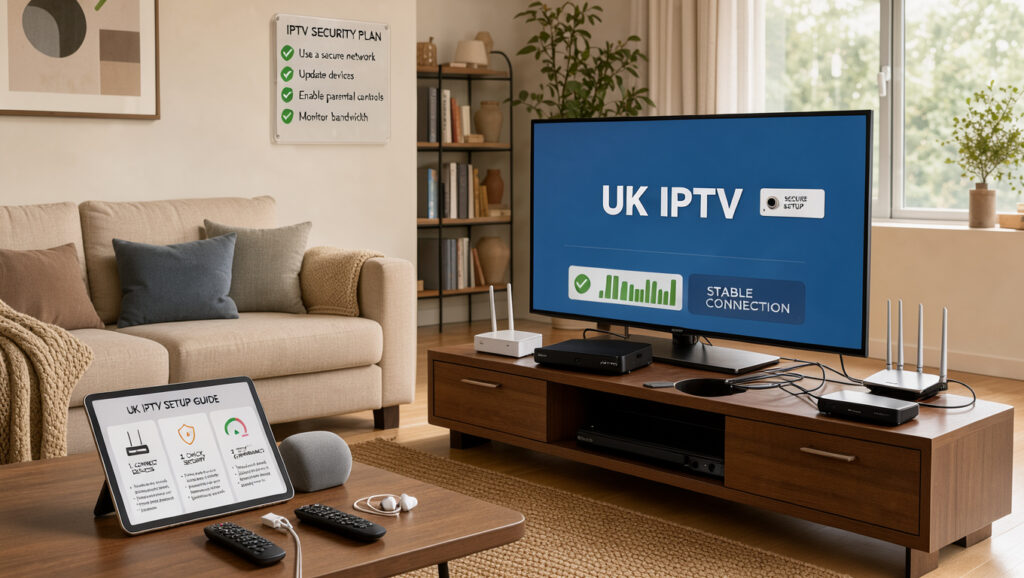
Imagine settling down after a long day to enjoy your favourite shows. You turn on your television and see a sleek interface, personalised recommendations, and a content library. This is the appeal of internet-based television, known as uk iptv in the UK.
This guide explains how to set up your IPTV service securely and efficiently. It covers key steps, including checking broadband speed and confirming device compatibility. Whether you use a smart TV, streaming device, or laptop, you can explore uk iptv with confidence.
You will also learn how to protect your account and compare connection plans. Plans start at just £13 for one to four connections. With the right setup, viewing can be smooth, but performance relies heavily on your internet connection and provider quality.
If this technology is new to you, do not worry. We explain everything in plain English and help you get the most from your IPTV experience. Let’s explore uk iptv together and get the most from your experience.
Key Takeaways
- Understand the basics of internet-based television.
- Learn how to check your broadband speed for optimal performance.
- Ensure device compatibility for a smooth streaming experience.
- Protect your account and data while streaming.
- Compare different connection plans to find the best value.
UK IPTV: Understand the service, benefits and legal basics
Internet Protocol Television (IPTV) is changing how people watch television. It delivers programmes through an internet connection instead of relying only on aerials, satellites or cable. Understanding IPTV helps you make an informed choice.
What internet television services provide
Internet television services offer features that can improve your viewing experience. Common options include:
- Live Channel Streaming: Enjoy real-time broadcasts of your favourite shows and events.
- Video-on-Demand Libraries: Access a vast library of movies and series at your convenience.
- Catch-Up Viewing: Watch programmes you missed at a later time.
- Replay Functions: Go back and watch segments of live broadcasts.
- Recording Options: Save your favourite shows for later viewing.
Many providers advertise long channel lists, but size does not prove reliability or legality. Always research the provider’s reputation and services.
Benefits and features, from live channel streaming to video-on-demand libraries
UK IPTV offers many benefits. It supports live channel streaming and video-on-demand libraries for flexible viewing.
- Accessibility: Watch content on various devices, including smartphones, tablets, and smart TVs.
- Cost-Effectiveness: Many IPTV services offer competitive pricing compared to traditional cable subscriptions.
- Flexibility: Choose from different packages tailored to your viewing preferences.
- Enhanced User Experience: Features like personalised recommendations and user-friendly interfaces make navigation easy.
These features create a flexible, enjoyable viewing experience that can suit your lifestyle.
Content licensing rules to check before you subscribe
Before choosing an IPTV service, understand the legal rules around content licensing. Some providers may not hold rights to distribute their content. Consider these points:
- Provider Transparency: Ensure the provider clearly outlines their licensing arrangements.
- Terms of Service: Review the terms of service for any hidden clauses or restrictions.
- Refund Policy: Familiarise yourself with the refund policy in case the service does not meet your expectations.
- Content Rights: Verify that the provider has legitimate rights to distribute the channels and shows they offer.
Being able to access a programme does not make its distribution lawful. Choose a reputable provider to help avoid possible legal issues.

Check your devices, apps and smart TV compatibility
Check your devices and apps before subscribing to enjoy IPTV without problems. Your television, streaming device, phone, or tablet must support the IPTV service you choose. Providers and apps may not support every operating system, so check compatibility first.
Before choosing a service, review these common device categories, including set-top boxes.
Compatible devices, including set-top boxes, streaming sticks and mobile devices
Many devices can run IPTV services well. These include:
- Set-top boxes: Devices like Amazon Fire Stick, Roku, and Apple TV.
- Streaming sticks: Compact devices that plug directly into your TV’s HDMI port.
- Mobile devices: Smartphones and tablets running on Android or iOS.
- Computers: Laptops and desktops with compatible operating systems.
- Smart TVs: Models that support IPTV apps natively.
Check your device’s exact model and operating system version. Older models may not support the latest apps or features. Also check its storage space and access to an app store for required applications.
Choosing an IPTV app and checking its compatibility
Choosing the right IPTV app is vital for a smooth experience. Depending on the app, you may need a provider login, playlist URL, portal address, or electronic programme guide (EPG) information. Download apps only from trusted official stores to avoid risks from unknown APK files or modified applications.
Smart TV and streaming support: what to verify before setup
For smart TVs and streaming devices, check these points:
- Resolution support: Ensure your TV can handle the resolution provided by the IPTV service.
- Audio compatibility: Verify that your TV supports the audio formats used by the IPTV provider.
- Remote-control usability: Confirm that your TV’s remote can navigate the IPTV app effectively.
- Software updates: Keep your TV’s software updated to ensure compatibility with the latest apps.
- Multiple device support: Check if your subscription allows multiple devices to be used simultaneously.
These checks can help make your IPTV experience smooth and enjoyable. For a full list of compatible devices, visit this resource.
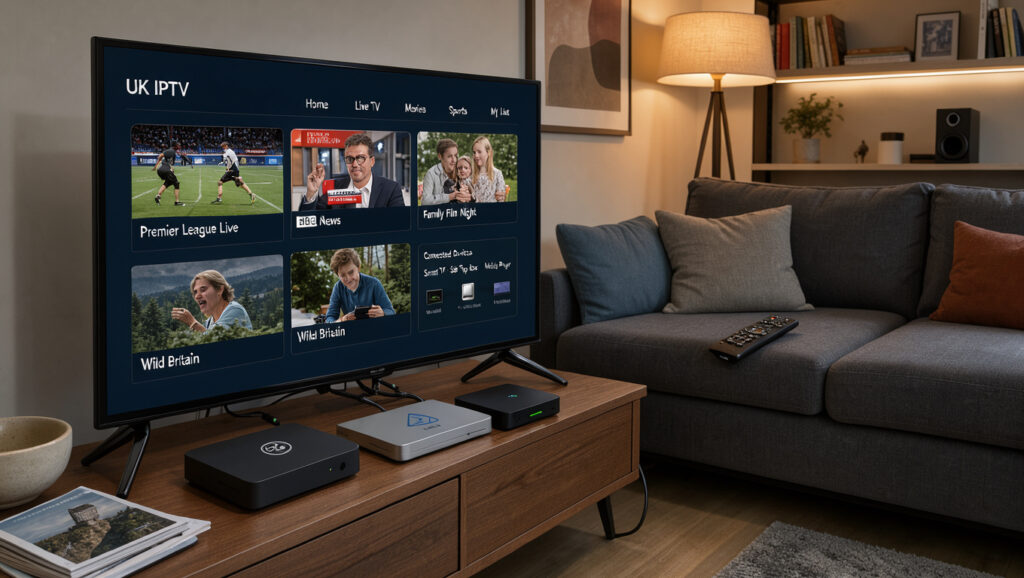
Step 1: Check your broadband and prepare your network
A reliable broadband connection supports smooth IPTV viewing. First, measure your broadband speed with an online speed test tool. Test in the same room and on the same device you will use for streaming.
Measure your broadband speed and estimate bandwidth requirements
Standard-definition video needs less bandwidth than high-definition or ultra-high-definition content. Use these broadband bandwidth requirements when planning to stream several channels at once:
- Standard-definition: Approximately 3-4 Mbps
- High-definition: Around 5-8 Mbps
- Ultra-high-definition: 25 Mbps or more
Also allow for gaming, video calls, and downloads. These activities can reduce the bandwidth available for IPTV.
Choose between Wi-Fi and a wired Ethernet connection
Next, choose between Wi-Fi and a wired Ethernet connection. The table below shows their main benefits and drawbacks:
| Connection Type | Pros | Cons |
|---|---|---|
| Wi-Fi | Flexible and convenient | Can be less stable; affected by distance and obstacles |
| Wired Ethernet | More stable and reliable | Less flexible; requires cabling |
Ethernet is usually better for your main television or set-top box because it offers greater stability. A strong, steady Wi-Fi signal can also work well.
Understand multicast streaming and your router’s role
Some IPTV services use multicast streaming, sending the same data stream to many users at once. This can improve performance, but your router must support it. Keep its firmware updated, and change advanced settings only when your provider advises you.
Place your router in a central, open location to reduce interference. If possible, use the less crowded Wi-Fi band.
For detailed guidance on setting up your IPTV service, visit this checklist.
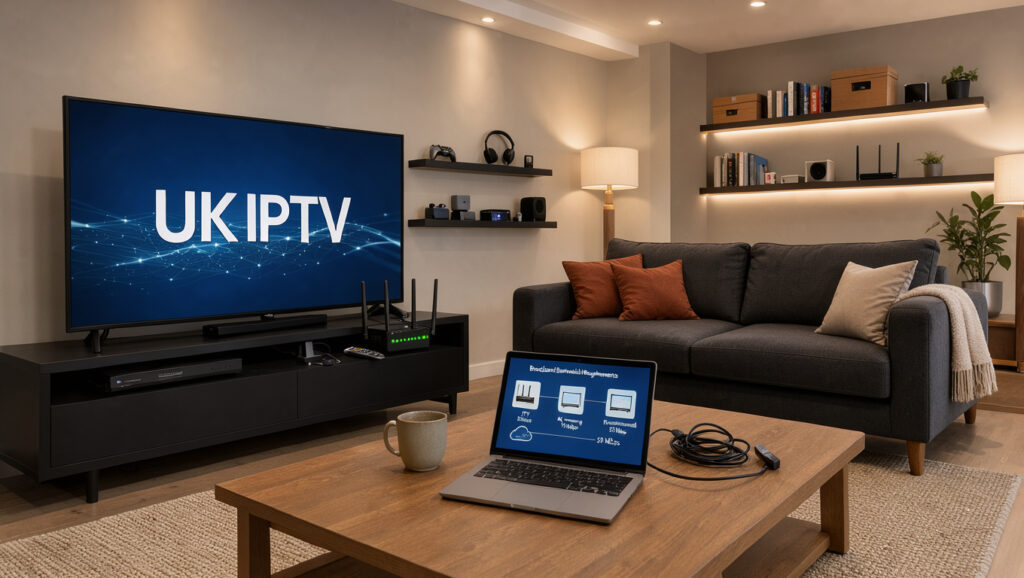
Step 2: Choose a service and install your IPTV app
Choosing the right IPTV service supports a smooth viewing experience. Compare providers carefully because many options are available.
Check device compatibility, channel choice, and service reliability. Also review customer support, privacy policies, and cancellation terms before deciding.
Compare providers and confirm device support, licensing and service terms
Start by comparing different IPTV providers. Check whether they support your device and operating system. Review the following points:
- Supported Devices: Ensure your chosen provider is compatible with your set-top box, smart TV, or mobile device.
- Available Channels: Look for a provider that offers the channels you want to watch.
- Service Reliability: Read reviews to gauge the provider’s performance and uptime.
- Customer Support: Confirm that they offer adequate support options if you encounter issues.
- Privacy Information: Understand how your data will be handled and whether the provider respects your privacy.
- Cancellation Terms: Familiarise yourself with the cancellation policy in case you decide to switch providers.
- Licensing Transparency: Ensure the provider operates legally and complies with content licensing rules.
Install the app on your device using numbered setup instructions
After choosing a provider, follow these steps to install the IPTV app:
- Confirm that your device and operating system are supported by the IPTV provider.
- Open the official app store or the provider’s verified installation page.
- Search for the recommended IPTV app and check its publisher for authenticity.
- Install the app and review the requested permissions before proceeding.
- Sign in using the subscription details provided by your IPTV provider.
- Add any authorised playlist, portal, or server information as instructed.
- Load the channel list and test playback to ensure everything works correctly.
Enter your subscription details and organise the electronic programme guide
After installation, set up your electronic programme guide. Electronic programme guides help you navigate channels and content easily.
If provided, enter the correct URL or account setting for the programme guide. Refresh the guide data occasionally when needed.
You can personalise your viewing experience by organising channel names into favourites or categories. This helps you find preferred content quickly. Never share login details publicly or enter them into unofficial applications.

Step 3: Set up streaming quality and test performance
To enjoy IPTV fully, configure streaming quality and test its performance. The right settings can make content play much more smoothly. Choose a suitable resolution and playback setting for your connection.
Select a suitable resolution and playback setting for your connection
First, choose a resolution that suits your internet speed and device capabilities. If broadband is inconsistent, start with lower resolution or adaptive playback. This can smooth streaming while you assess reliability, then increase quality once performance stabilises.
Improve buffering, loading times and live channel streaming
Buffering can frustrate viewers during live channel streaming. Use wired Ethernet instead of Wi-Fi whenever possible for a more stable connection. Pause large downloads, restart your router and app, and close unused applications to free bandwidth.
Repeated buffering with only one provider may show a service-side capacity issue, not a home-network fault. Monitor loading times and streaming quality to spot problems early.
Test live channels and video-on-demand across your devices
Testing ensures your IPTV service works correctly. Check a popular live channel, a less frequently viewed channel, a high-resolution stream and an on-demand programme. This varied test gives you a broad view of service performance.
During testing, check startup times, picture quality, audio synchronisation, channel changes and playback stability. Watch for at least several minutes to identify issues with your IPTV setup.
These steps can greatly improve your IPTV experience and live channel streaming. For further help choosing a suitable plan, see the available pricing options.
Protect your account, devices and streaming privacy
A safe streaming environment protects your personal information and privacy. Use essential security measures to enjoy your IPTV service safely.
Use strong passwords, trusted apps and secure device settings
Use a unique, complex password for your streaming account. Combine letters, numbers and symbols for better protection. Enable multi-factor authentication if your provider offers it.
Download applications only from trusted, reputable sources. Update your streaming devices, routers and apps regularly to fix security weaknesses. Remove unused apps and check their permissions to protect your privacy.
When a VPN may help, and what it cannot do
A VPN encrypts your internet traffic and can improve privacy, especially on public networks. However, it cannot make an unauthorised service lawful or guarantee faster streaming. Speed may change because of server distance and congestion.
A VPN adds security but cannot replace a secure home network. Always follow your provider’s terms, local laws and content licensing rules when accessing content.
Keep privacy and content licensing rules in mind
Follow content licensing rules when using your IPTV service. Privacy tools should support responsible use, not hide copyright infringement or bypass lawful access controls. Understanding these rules helps create a lawful streaming experience.
| Security Measure | Description | Benefits |
|---|---|---|
| Strong Passwords | Use a mix of characters for complexity. | Prevents unauthorized access. |
| Trusted Apps | Download only from reputable sources. | Reduces risk of malware. |
| VPN Usage | Encrypts internet traffic. | Enhances privacy on public networks. |
| Regular Updates | Keep devices and apps updated. | Protects against vulnerabilities. |
| Review Permissions | Check app permissions regularly. | Maintains control over personal data. |
For more information about protecting your streaming account, visit our refund policy page.
Compare UK IPTV connection plans and prices
To get the most from your uk iptv service, compare connection plans and their costs. Before choosing, check how many simultaneous connections your household needs. Each provider may offer different options; the connection number shows how many devices can stream at once.
When choosing a plan, consider your household’s viewing habits. If you live alone and watch on one device, one connection may be enough. Families watching different channels may need two, three, or four connections.
How to Choose a Plan Based on the Number of Simultaneous Connections
Here’s a breakdown of the connection options:
| Connections | Ideal For | Monthly Price |
|---|---|---|
| 1 Connection | Single viewer | £5.99 |
| 2 Connections | Couples or small families | £9.99 |
| 3 Connections | Medium-sized families | £12.99 |
| 4 Connections | Larger families or shared households | £15.99 |
Longer subscription terms often offer a lower effective monthly cost. Before choosing one, review the cancellation and refund policies. This helps you avoid a service that does not meet your needs.
Choose a uk iptv plan that matches your actual use, rather than the largest option. Review your household’s viewing patterns to make an informed choice for everyone.
Fix common setup and performance problems
Problems with internet television services can feel frustrating. Common issues include buffering, app errors, freezing and missing channels. Simple checks can often restore smooth viewing.
Identify whether buffering comes from your network, device or service
Buffering may come from your network, device or service. If all apps and websites are slow, check your broadband connection and run a speed test. For one affected device, restart it, check storage, update its operating system, and test another network.
Follow practical fixes for app errors, freezing and missing channels
Check that the app came from a trusted source, then reinstall it if errors continue. For freezing, lower resolution, use wired Ethernet, or move closer to your router. Missing channels may reflect an outdated playlist or licensing restriction; avoid repeatedly entering random server details, which may complicate matters.
Keep your app, device and network settings up to date
Regular maintenance keeps internet television services running smoothly. Keep your app, device firmware, router firmware, and security settings up to date. Before contacting support, record error messages because they can help with troubleshooting.
In the words of a seasoned IPTV user,
“A little maintenance goes a long way in ensuring uninterrupted viewing.”
Conclusion
Start by checking that your IPTV provider is legitimate and suits your needs. Check device and app support for set-top boxes, smart TVs, and streaming sticks. Test your broadband speed to support smooth streaming.
After installing your IPTV app from a trusted source, set up your electronic programme guide and choose playback quality. Test live channels and video-on-demand libraries on every device to find possible issues. Devices may behave differently, so test each one carefully.
Security should not be overlooked. Strong passwords and updated software help protect your account and home network. A VPN may improve privacy, but it cannot replace legitimate access to content; understand its performance and legal limits.
For more insight into the best IPTV services, read this comprehensive guide here. With the right preparation and knowledge, you can enjoy a robust streaming experience that suits your preferences.
FAQ
What are UK IPTV services?
UK IPTV services are internet television platforms. They deliver programmes through an internet connection, with live channels and video-on-demand libraries. This avoids relying only on traditional cable or satellite methods.
What benefits do UK IPTV services offer?
UK IPTV services offer live channel streaming, catch-up viewing, replay functions, and large video-on-demand libraries. These features support flexible viewing on multiple supported devices.
How can I ensure the legality of an IPTV service?
To check an IPTV service’s legality, review the provider’s licences, company details, and terms of service. Look for clear information about content rights, and avoid services promising premium content cheaply.
What devices are compatible with UK IPTV?
UK IPTV works on set-top boxes, streaming sticks, smart TVs, Android and Apple mobile devices, tablets, and computers. Always confirm your specific model and operating system before subscribing.
How do I check my broadband speed for IPTV?
Test your broadband speed on the same device you plan to use for streaming. This shows whether your connection meets the bandwidth needs for your chosen quality.
What are the broadband bandwidth requirements for IPTV?
IPTV bandwidth needs depend on the streaming quality. Standard-definition video usually needs less bandwidth than high-definition or ultra-high-definition playback. Several simultaneous streams also need extra capacity.
What is multicast streaming?
Multicast streaming delivers content to several users at the same time over a network. It can improve efficiency but needs suitable router support and settings. Optimise your router for multicast if your IPTV service uses it.
How do I install an IPTV app on my device?
First, confirm that your device supports the IPTV app. Open the official app store or the provider’s verified installation page, find the app, and follow the instructions. Download only from trusted sources.
How can I improve streaming performance?
Choose a resolution that suits your connection speed, and use a wired Ethernet connection when possible. Stop other high-bandwidth activities, and test different content types to find performance issues.
What security measures should I take for my IPTV account?
Use a strong, unique password for your IPTV account and enable multi-factor authentication if available. Keep your devices and apps updated, avoid sharing credentials, and use only trusted applications.
When might a VPN be beneficial for IPTV users?
A VPN can improve privacy by encrypting internet traffic, especially on public networks. However, it cannot make an unauthorised service lawful or guarantee faster streaming. Always follow your provider’s terms and local laws.
How do I choose the right IPTV connection plan?
Choose an IPTV plan based on the number of simultaneous connections your household needs. Prices usually vary by connection numbers, so select a plan that fits your usage without overspending.
What should I do if I encounter buffering issues?
If buffering occurs, check your network speed first. If it continues, lower the resolution, use a wired connection, or close other bandwidth-heavy applications. Buffering on one service may show a provider problem.